Welcome to Visiting Angels
Locate Care Employment Opportunities Contact Us
SEARCH Use the up and down arrows to select a result. Press enter to go to the selected search result. Touch device users can use touch and swipe gestures.
Creative Ways to Pay For Senior Home Care
If your aging loved one needs home care, you may wonder if your family can afford it. Luckily, there are various payment options, but financial situations vary.
Providing Comforting Support During Hospice Care
When a loved one is approaching the ending stages of life and enters hospice, it's crucial to focus on cherishing your final moments together without any distractions.
Protect Your Elderly Loved One From Phone Scams
Protecting seniors from phone scams is critical. Scammers increasingly exploit their generosity and limited internet knowledge.
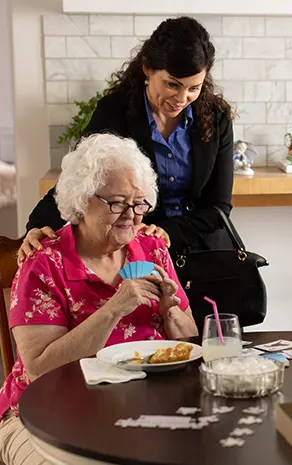
A Visiting Angels caregiver comforting an elderly woman with Alzheimer's, highlighting compassionate support in a peaceful home setting. A Visiting Angels caregiver comforting an elderly woman with Alzheimer's, highlighting compassionate support in a peaceful home setting. A Visiting Angels caregiver comforting an elderly woman with Alzheimer's, highlighting compassionate support in a peaceful home setting.

Get Started with In-Home Alzheimer’s Care

Making decisions about in-home senior care for a loved one with Alzheimer’s can be overwhelming. At Visiting Angels, we have more than 25 years of experience in easing the transition through these life changes for families across the U.S.

Whether you are ready to begin with our specialized services right away or simply interested in learning more, we will make the process as easy as possible.

01
Schedule a Free Home Care Consultation
A Visiting Angels coordinator will meet with your family to discuss specific needs and expectations during a free home care consultation. We'll answer your questions and let you know how professional caregivers can help.
A blue circular arrow icon.
02
Create A Customized Care Plan
If you choose Visiting Angels, your coordinator will arrange a home care assessment, including a walk-through of your loved one’s home to monitor any safety hazards, fall risks, and opportunities to optimize the dwelling. The coordinator will then develop a detailed plan and schedule with your approval.
A blue circular arrow icon.
03
Meet Your Caregiver
We thoroughly screen and select the best professional caregivers for families. We’ll match you with the ideal caregiver based on your loved one’s condition, needs, preferences, and personality. You’ll feel confident knowing your loved one is safe and comfortable at home with a Visiting Angels’ caregiver by their side.

Contact Us About Our Home Care

Call 800-365-4189 or fill out the form below.

PLEASE SELECT

By submitting this form, I agree to be contacted by Visiting Angels via call, email and text. To opt out, you can reply 'stop' at any time or click the unsubscribe link in the emails. Message and data rates may apply. Learn more on our Privacy Policy page.
This site is protected by reCAPTCHA and the Google Privacy Policy and Terms of Service apply.

Frequently Asked Questions

What Is Alzheimer’s Disease?

Alzheimer’s disease is a progressive, degenerative brain disorder characterized by memory loss, cognitive decline, and behavioral changes. Symptoms worsen over time, usually over several years, and can have a severe effect on performing daily tasks and activities.

Alzheimer’s is considered a terminal condition, with an average life expectancy of 4 to 8 years after diagnosis, though some individuals live 15 or 20 years after their initial diagnosis.

What Is the Difference Between Alzheimer’s and Dementia?

Dementia is an umbrella term for a wide range of brain disorders that are characterized by memory loss. Alzheimer’s is the most common type of dementia. According to estimates, Alzheimer’s cases account for somewhere between 60% to 80% of all cases of dementia.

Everyone with Alzheimer’s has dementia, but not everyone with dementia has Alzheimer’s. People living with vascular dementia, for instance, have symptoms similar to Alzheimer’s but the cause of their dementia is different.

What Are the Risk Factors for Alzheimer’s Disease?

While scientists are still researching the exact cause of Alzheimer’s disease, researchers have identified a number of risk factors. The three biggest risk factors are:

  • Advanced age: In most cases, symptoms of Alzheimer’s disease begin after age 65.
  • Genetics: People with a family history of Alzheimer’s are at higher risk of developing the disease themselves.
  • Heart health: Poor cardiovascular health increases one’s risk. Those with a history of high blood pressure, high cholesterol, diabetes, stroke, or heart attack will be at higher risk.

Other risk factors include:

What Are the Symptoms of Alzheimer’s?

Researchers believe the disease begins many years before signs appear. Symptoms typically start to appear in aging adults, though some cases of Alzheimer’s begin in a person’s 40s or 50s.

At first, symptoms will be mild and will have minimal impact on the person’s well-being. As the disease progresses, symptoms develop from mild to moderate to severe. By the final stages of the disease, the person may lose all short-term and long-term memory, the ability to speak and to understand speech, and the ability to perform basic personal activities, such as how to use the bathroom or eat on their own.

What If My Loved One With Alzheimer’s Can No Longer Live At Home?
Visiting Angels offers services in assisted living and nursing home facilities. Because staff members at these facilities tend to look after more than one older adult during shifts, families decide to hire a professional caregiver to supplement the facility’s services. As needs change, we can increase the duration or frequency of care for your loved one, day or night.

Is There a Cure for Alzheimer’s Disease?

Currently, there is no known cure for Alzheimer’s disease, and its progress is believed to be irreversible. While researchers continue to search for a cure, modern treatments and clinical trials are working toward slowing disease onset, delaying symptoms, and reducing progression.

Doctors recommend that people at risk of or living with Alzheimer’s disease focus on healthy lifestyle choices, particularly focusing on cardiovascular health. Interventions such as improved sleep habits, increased omega-3 intake, and decreased stress are also proven to reduce the risk.

What Are the Care Options for My Loved One With Alzheimer’s?

As Alzheimer’s progresses, people living with the disease need high levels of in-home memory care to ensure their well-being and safety. Friends or family members may care for your loved one with early and mid-stage Alzheimer’s. As the disease reaches its later stages, professional support is often needed.

Moving your loved one into a nursing care facility is an option. However, this can be a traumatic experience, and it is typically considered a last resort. Another option is to hire Alzheimer’s home care services, such as those offered by Visiting Angels. Our specialized home caregivers help people age in place with Alzheimer’s disease.

What If My Loved One With Alzheimer’s Can No Longer Live At Home?
Visiting Angels offers services in assisted living and nursing home facilities. Because staff members at these facilities tend to look after more than one older adult during shifts, families decide to hire a professional caregiver to supplement the facility’s services. As needs change, we can increase the duration or frequency of care for your loved one, day or night.